Understanding BEP is one of the most important steps toward building and operating a reliable water pumping system.
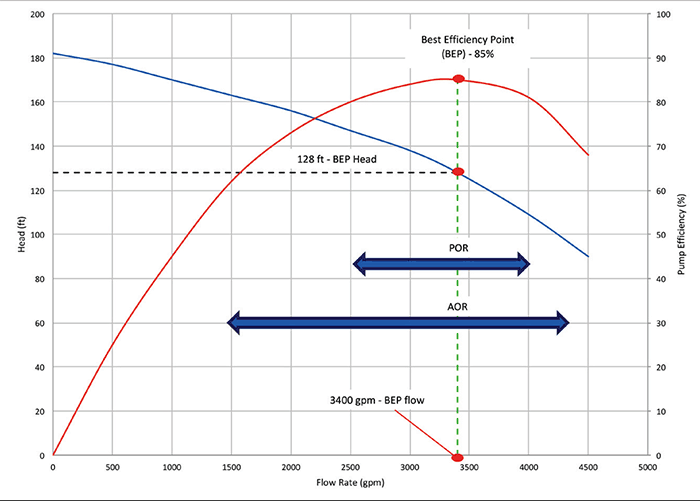
When engineers talk about pump performance, one concept appears again and again: Best Efficiency Point, often shortened to BEP.
Understanding BEP is one of the most important steps toward building and operating a reliable water pumping system.
The Best Efficiency Point is the operating condition where a pump moves water with the greatest hydraulic efficiency.
At this point, the pump converts the most input energy into useful water movement and loses the least energy to heat, turbulence, vibration, and mechanical stress.
On a pump performance curve, BEP is typically found near the peak of the efficiency curve.
When a pump operates near this point, it experiences:
In simple terms, BEP is where a pump runs the way it was designed to run.
Many pumping systems are designed correctly at the beginning but drift away from BEP over time.
This can happen because of:
When pumps operate too far left or right of BEP, problems begin to appear.
Operating below BEP (low flow) can cause:
Operating above BEP (high flow) can lead to:
Over time, these conditions accelerate wear and shorten equipment life.
While BEP represents a single point on the curve, pumps are typically designed to operate within a Preferred Operating Region (POR).
This region is often defined as:
70–120% of the Best Efficiency Point flow rate
Within this range, pumps can operate reliably without excessive mechanical stress.
Outside that range, system performance begins to decline.
When evaluating a pumping system, BEP provides a clear reference point.
It allows engineers and consultants to answer critical questions:
At BEP Pump Consultants, this concept guides how systems are evaluated and improved.
Rather than focusing only on individual components, we look at how the entire system behaves over time.
When pumps operate near their Best Efficiency Point, systems become:
And that’s exactly the outcome every water system should deliver.